
If your team is investing in video, the real question is not who can make something that looks polished. It is whether the industrial video production company you hire understands how manufacturers sell, how buyers evaluate technical solutions, and where video actually moves revenue. In manufacturing, a good-looking video that does not help sales, recruiting, training, or trade show performance is just another line item.
That is why the selection process matters. The right partner will help you clarify the job each video needs to do, then build content around that objective. The wrong partner will focus on visuals first and leave your team with an asset that gets compliments but does very little for the business.
What an industrial video production company should actually deliver
A true industrial video production company does more than show up with cameras and edit a final file. It should understand plant environments, technical products, long sales cycles, and the internal pressures that marketing and sales teams face. That includes explaining complex processes clearly, capturing equipment safely, and producing content that supports a buyer from first impression to final decision.
For manufacturers, video usually needs to do one of a few specific jobs. It might attract qualified traffic through search, help a sales rep answer common objections, show a facility to buyers who cannot travel, improve trade show engagement, or shorten training time for employees and channel partners. Those use cases require strategy, not just production.
That is the dividing line between a generalist agency and a specialist partner. A generalist may be capable of filming machinery or interviewing your team. A specialist knows why a facility tour helps build trust, how a product demo should be structured for a technical audience, and when an FAQ video library will outperform a single brand film.
Why manufacturers need a specialized industrial video production company
Manufacturing businesses do not sell like consumer brands, and they should not buy video the same way either. Most industrial purchases involve multiple stakeholders, technical scrutiny, and a sales process that unfolds over weeks or months. Buyers want proof. They want clarity. They want to see how your operation works and whether your team can deliver.
A specialized industrial video production company understands that your marketing content has to support both visibility and conversion. That might mean creating overview videos for your website, detailed product videos for sales conversations, recruiting content for hiring, and training videos that reduce onboarding time. These are different assets with different goals, and treating them as one generic project usually leads to weak results.
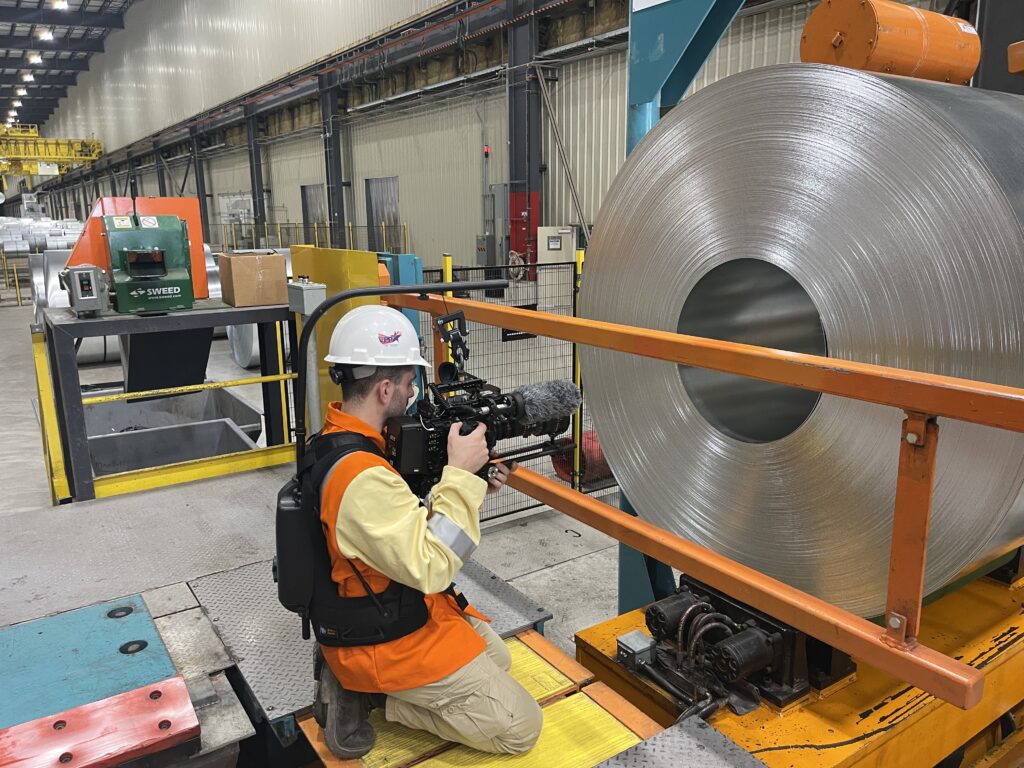
There is also a practical side. Filming in active manufacturing environments requires planning around safety, production schedules, lighting limitations, noise, and access restrictions. A partner with industrial experience will know how to work efficiently without disrupting operations or missing the shots that matter.

How to evaluate an industrial video production company
The first thing to look for is business alignment. Ask how they define success. If the conversation stays centered on style, drone shots, and editing effects, that is a warning sign. A strong partner will ask about lead quality, sales enablement, recruiting bottlenecks, training inefficiencies, and trade show goals before they talk about creative treatment.
Next, review their experience with industrial and B2B clients. You are not just looking for footage of factories. You are looking for evidence that they understand technical messaging and can structure content around a commercial objective. A product video for a complex machine is not successful because it looks cinematic. It is successful because a prospect watches it and understands why your solution fits their operation.
Process matters just as much as portfolio. Ask how they handle planning, interviews, scripting, on-site production, approvals, and revisions. Ask how they identify the right subject matter experts and how they turn internal knowledge into customer-facing content. Manufacturers often struggle because the people who know the product best are not always the people best suited to explain it on camera. An experienced team can bridge that gap.
You should also ask how they think about distribution. Video only performs when it is built for where it will be used. A homepage video, a trade show loop, a sales follow-up video, and a training module all require different pacing, structure, and calls to action. If a company cannot explain how the same shoot can produce multiple business-ready assets, you may end up paying for content that is too narrow to deliver a strong return.
The questions worth asking before you hire
A few questions will tell you quickly whether a production partner is thinking like a business partner.
Ask what kinds of videos they recommend for manufacturers and why. Ask how they measure results. Ask how they help clients repurpose footage across sales, marketing, recruiting, and training. Ask what they need from your team to keep the process efficient. Ask how they approach messaging for technical buyers who may not know your terminology.
It is also worth asking what they would not recommend. Good partners understand trade-offs. For example, a high-end corporate brand film may have value, but if your sales team lacks product demos, FAQ videos, or facility content, that budget may be better spent elsewhere. The best industrial video production company will tell you where video has the highest commercial value, not just where the production scope is largest.
What good results look like
Video ROI in manufacturing does not always show up in one simple metric. Sometimes it looks like more qualified website inquiries. Sometimes it shows up as faster sales conversations because prospects have already seen your process, products, or answers to common concerns. Sometimes it comes from better trade show booth engagement or reduced time spent repeating the same explanations in every sales call.
Internal gains matter too. Training videos can improve consistency across locations, reduce downtime for supervisors, and give new hires a clearer path into their roles. Recruiting videos can help candidates understand your environment before they ever apply. A company that understands industrial operations will recognize that video is often as much an operational tool as a marketing one.
This is where a strategy-led approach pays off. Instead of asking for one video, manufacturers often get better results by building a useful content set. A facility tour can establish credibility. Product videos can explain capabilities. FAQ videos can support sales reps. Trade show content can attract attention in person. Training modules can strengthen internal execution. The value compounds when each asset has a clear role.
Red flags to avoid
If a provider cannot explain how video supports your sales process, be careful. If they treat every client the same, be careful. If they pitch a single flagship video without discussing supporting assets, distribution, or reuse, be careful.
Another issue is overemphasis on creativity without enough attention to message clarity. Manufacturing buyers do not need vague storytelling. They need confidence in your capability, your process, and your solution. Strong production quality matters, but clarity and relevance matter more.
It is also worth watching for teams that underestimate the complexity of your environment. Industrial filming is not the same as a corporate office shoot. Safety, plant schedules, product sensitivity, and technical accuracy all matter. A partner that does not ask about those details early may create delays later.
A better standard for industrial video production
The manufacturers that get the most from video usually stop thinking about it as a standalone marketing asset. They treat it as part of the sales process, part of the training system, and part of how the company presents itself to buyers who need proof before they commit.
That is the standard your production partner should meet. An industrial video production company should help you decide what content is worth making, how it should be used, and how it will support measurable business outcomes. Production quality still matters, but in this space, strategy is what makes the investment work.
For companies that want video to do more than sit on a website, that distinction is not minor. It is the difference between content that looks good and content that helps move the business forward. Video For Manufacturing is built around that practical standard, because manufacturers do not need more content for content’s sake. They need assets that help teams sell, train, and grow with less friction.
Before you hire anyone, make sure they can speak to that reality in plain terms. Contact us for a free strategy guide!


